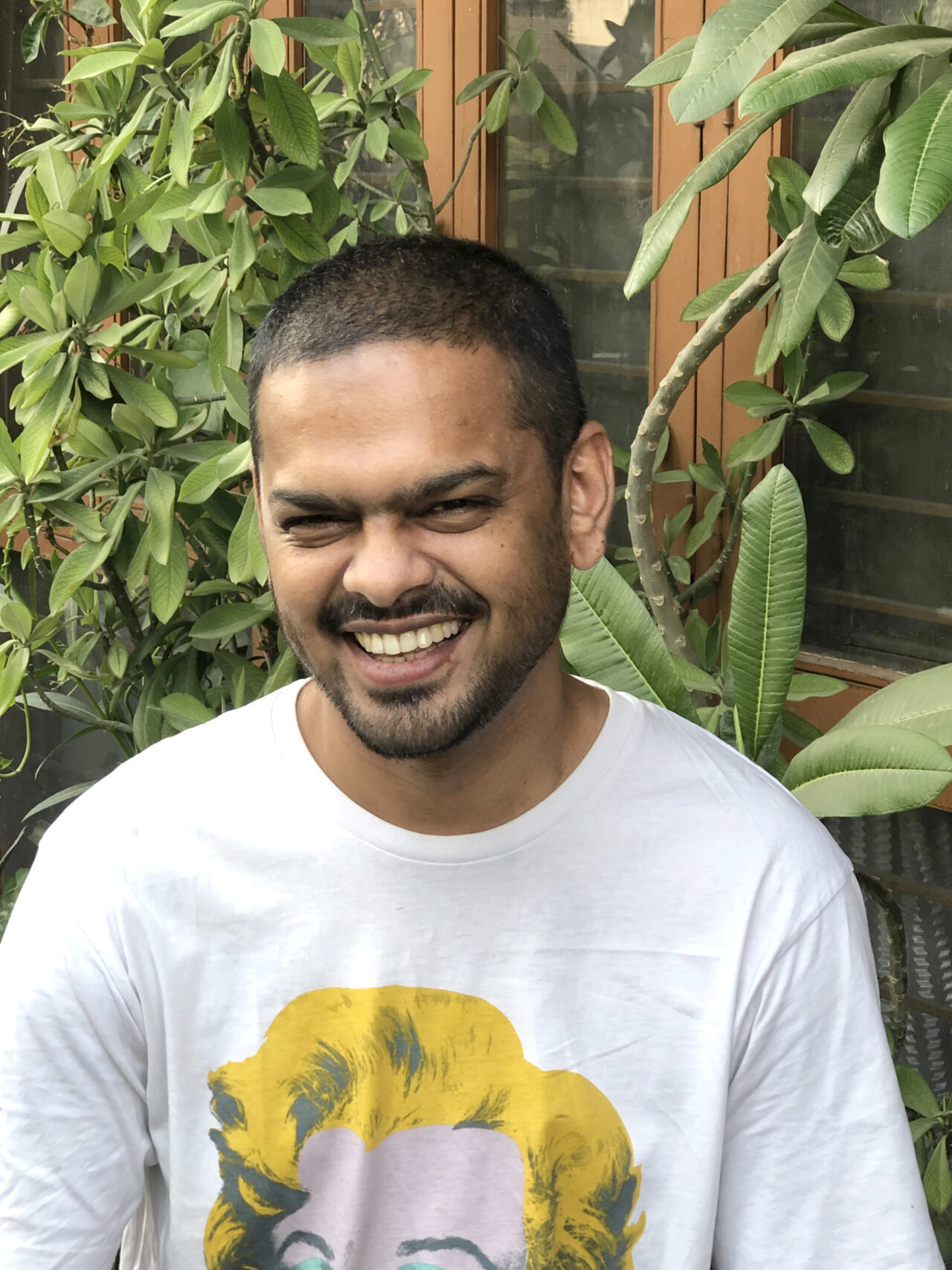
Paribartana Mohanty (b.1982/Odisha) is a multimedia artist, working with new media, video, performance lectures, and painting.
His recent work explores new ‘environmental disaster landscapes’ emerging near the coast of the Bay of Bengal in Odisha and studies the deep impacts of recurring cyclones, tsunamis, and land erosion on marginal communities, nature, and culture.
Paribartana’s interest and research are in examining how technologies of algorithmic networks, digitalization, data mining, access, and surveillance are shaping public perception about “natural” calamity, and how new government policies are changing the rural landscapes in Odisha.
His work has been exhibited in many group exhibitions and film festivals, including MACAN Museum, Indonesia; Ars Electronica Festival, Linz (2022); New Museum, New York (2022); Chennai Photo Biennale 3 (2022); 35th European Media Art Festival at Osnabrück (2022); 4th VH Award and EYEBEAM (2021); Goethe Institute, Mumbai (2022); Transart Triennale, London (2016); 45th International Film Festival Rotterdam (2016); 59th BFI London Film Festival (2015), Institute of Contemporary Art Singapore (2015); and Institute of Contemporary Art, Lyon, France (2013), among others. His last two solo exhibitions were organized by Vadehra Art Gallery, New Delhi, in 2012 and 2018.
He is a member of the artist collective WALA and worked as one of the curators for the Kochi Students’ Biennale, which was part of the Kochi Muziris Biennale (2016).
Mohanty has presented and performed at the Sharjah March Meeting; Goethe Institute New Delhi; South Asia Institute at Harvard University, Boston; School of Arts and Aesthetics (JNU); InC gathering of artists, Dhalao and Sarai Reader CSDS, New Delhi; Kochi Muziris Biennale Symposia; T.A.J. Residency & SKE Projects (2015), Bengaluru, among others.
He earned a BFA from Dhauli College of Art and Craft, Bhubaneswar (2004), and an MA in History of Art from the National Museum Institute, New Delhi (2006).
Paribartana currently lives and works in Delhi and Odisha.
Behind The Screen: Meet Paribartana Mohanty
Paribartana Mohanty (b. 1982, Orissa, India) is a New Delhi artist who trained in painting and works in video. He is interested in how algorithmic networking, digitalization, data mining, accumulation, access, and dissemination shape public perception and opinion about natural calamities, especially among marginalized communities. For his VH AWARD project, he will explore how visual simulations, digital graphics, special effects, and tagging and tracing are “manufacturing a new common aesthetic and affecting the ‘solidarity’ debate around ecological issues.”
Tell us what your response was to being shortlisted?
I was excited to get the production grant that would allow me to pursue this research and work, which I was wanting to explore for a long time in my local context in Odisha, the state in India I come from. I have been living and practicing in New Delhi for the last 15 years, and looking for support that would allow me to dig deeper into Odisha’s cultural, ecological, and technological scene. The scope, processes, and longevity of this project and grant give me that chance. I’m thrilled to be on this journey.
May we ask you to tell us about your critical interest in how algorithmic networking, digitalization, data mining, accumulation, access, and dissemination shape public perception and opinion about natural calamities, especially among marginalized communities? How does this inform your practice?
In a broader sense, my interest lies in how new technologies mediate information or knowledge. There is no absolute truth or nature in the present, as we used to believe earlier. The so-called “mother nature” itself is mediatized. In the post-digital, post-truth era, representation alters the real.
In the context of communication technology, such as radio, the internet, social media, and mobile phones, etc., it not only provides the ease to create an image or story but also helps to circulate critical information instantly. This rapid spread of information also helps to change opinions and perceptions greatly. We create our individual unique worlds—which of course are governed by algorithms and networks.
In the context of the environmental crisis, generally speaking, people in Odisha have been used to religious texts as a source to grasp natural calamity. Now with communication mediums and technology, people are significantly informed. They understand that a “natural calamity” is no longer strictly natural. Every natural disaster is in some way man-made or has a footprint of human intervention. This realization is emancipating many marginalized communities, who are now able to raise their voices. New technology is helping them amplify their unique voices. People in remote areas are now familiar with terms like “global warming” and “ecology.” For instance, most fishermen communities in Odisha are conscious of their geopolitical locations, that in most cases their proximity to the river and water diversion interferences by authorities is one of the causes of land erosion near the sea and loss of life, homes, and livelihoods. They are questioning, amplifying, and asking for solutions from the government. The village of Ramayapatnam in the state of Andhra Pradesh (which borders part of the state of Odisha) is a current hotspot of rapid erosion caused by the expanding sea. It is one of the sites in my project. Another example is the 2018 Kerala floods, during which social media played an important role in gathering and circulating information, solidarity, and support.
In Odisha, when a cyclone comes and roots out trees, towers, electricity poles, and wires, and causes blackouts for not days but months on end in the remotest areas, it is a different story. I’m interested in this polarity. On one level we say “post-internet, post-digital era,” and at the same time, there is no electricity. And there is no contact. My concern comes from this irony.
And would you elaborate on how you see digital graphics, special effects, tagging, and tracing as “manufacturing a new common aesthetic and affecting the ‘solidarity’ debate around ecological issues”?
In India, social strata or class, caste, and religion prominently control the common aesthetic sensibilities. Social hierarchies and geopolitics influence how culture plays out in the public domain. Communities and friendships are built according to one’s “already reserved” associations or social background.
On one side this layering makes the culture diverse and provocative, but on the other side creates stereotypical conservative radical groups. New technology apps and devices neutralize some of these intensities. The young generation uses technology to project their aspirations, dreams, and doubts on social media. That’s why Apps like TikTok become so popular and cause a humongous class divide and uproar in [what has become known as] the Third World, making an entirely earlier invisible population visible with their own content and voice. The politics of “entertainment” changes hugely with that. People fight for this sense of freedom and expression.
In the recent past, we have seen how solidarity communities emerge instantly when there are issues related to socio-political dysfunctionality of governments or climate crisis globally. People feel connected across time and geography. At the same time, there is a huge crackdown from local governments to suppress, erase, delete, and ban certain hashtags, tagging, “toolkits,” memes, and posts—and I say this particularly in relation to the last two years’ crackdown by the Indian government on many such solidarity-raising communities doing essential urgent work during the pandemic. In India, we are witnessing a massive wave of government-supported, mediatized, and bot-enabled propaganda work versus pro-public solidarity groups.
What excites me is the slippage between the two. There is a lot that finds its way through, despite restrictions. When the glacier burst in Uttarakhand’s Chamoli district on February 7, 2021, and resulted in an avalanche and deluge, there were stories of villagers finding refuge in nearby forests and being afraid to come back to their village. In the beginning, what people believed was a natural disaster turned out to be a man-made one. The media images were heart-wrenching but immediately affected the “solidarity” debate around what we think or perceive as natural beings not natural, but man-made.
May we ask you to tell us how you are using your online residency with Eyebeam? How is it supporting your ability to realize your project?
Eyebeam’s online residency and interaction with experts are helping me to evaluate my project. Mentors’ suggestions, references and readings, Q&A, and discussions are opening up exciting dimensions. It helps me articulate the scope of my project and expand my vocabulary and knowledge.
