Page contents
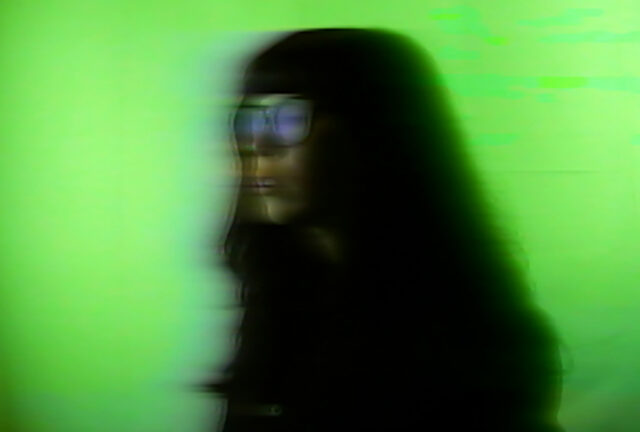
Pictured is artist Chloe Alexandra Thompson. She is a Cree person with long dark hair. A blurred image depicts a person in profile wearing glasses against a neon green background, conveying a sense of motion and digital distortion.Pictured is artist Chloe Alexandra Thompson. She is a Cree person with long dark hair. A blurred image depicts a person in profile wearing glasses against a neon green background, conveying a sense of motion and digital distortion.

Portrait of Eyebeam resident, Chloe Alexandra Thompson. Photo Courtesy of the artist.

With Chloe Alexandra Thompson
Pronouns
She/her
Date and place of birth
Treaty 6, Edmonton, Alberta, CAN
Current location
Brooklyn, NY (Lenapehoking)
Year(s) of residency and/or fellowship
2026, Speculating on Plurality Resident

Special to Feed


Artist Bio

Chloe Alexandra Thompson is a Nêhiyaw (Cree) interdisciplinary artist and composer working with sound as a relational medium. Her practice explores listening as a way of knowing, shaped by Indigenous acoustic ecology and embodied practice, in which tone, texture, and resonance shape perception beyond fixed narrative. Thompson utilizes field recording, synthesis, and psychoacoustic techniques which unfold as durational environments, installations, and long form performances to compose participatory encounters between humans, technologies, and landtreating sound as both material and method, capable of holding memory, disrupting linear time, and creating space for reflection and attunement. A current Onassis ONX Studio member, she has participated in residencies at Pioneer Works, MIT OpenDoc Lab with the Indigenous Screen Office of Canada, and HERVISIONS x Arebyte (UK).


Tell us about yourself.

CT: I am a member of Beaver Lake Cree Nation, and was born in Treaty 6 territory located in so-called Alberta, Canada. I spent my childhood primarily on Coast Salish territory in Vancouver, British Columbia. I moved to the US in 2012 and have lived in Portland, Oregon, where I attended college, as well as Lenapehoking (New York), and Ogaa Po’oge (Santa Fe, NM).

For some years, I have been considering how artists are often tasked with creating Futurisms through ideas or to work towards some idea of Utopia, especially in a world where things can often feel stuck. In my own practice, life, and relationships, I have become much more interested in considering how this practice of futuring in the present can bring forward the past into a form of repair. My friend Dr. Joseph M. Pierce has done a really beautiful job of outlining this in his work Speculative Relations: Indigenous Worlding and Repair [Duke University Press, 2025]. Pierce’s applied research in this work brought into context so many feelings I had around working with the past and shifting the outside gaze towards Sovereignty. Storytelling is a means to contextualize forms of agency and resilience (but not in a fetishized sense), and this has ultimately inspired my own practice of sharing my experiences. 
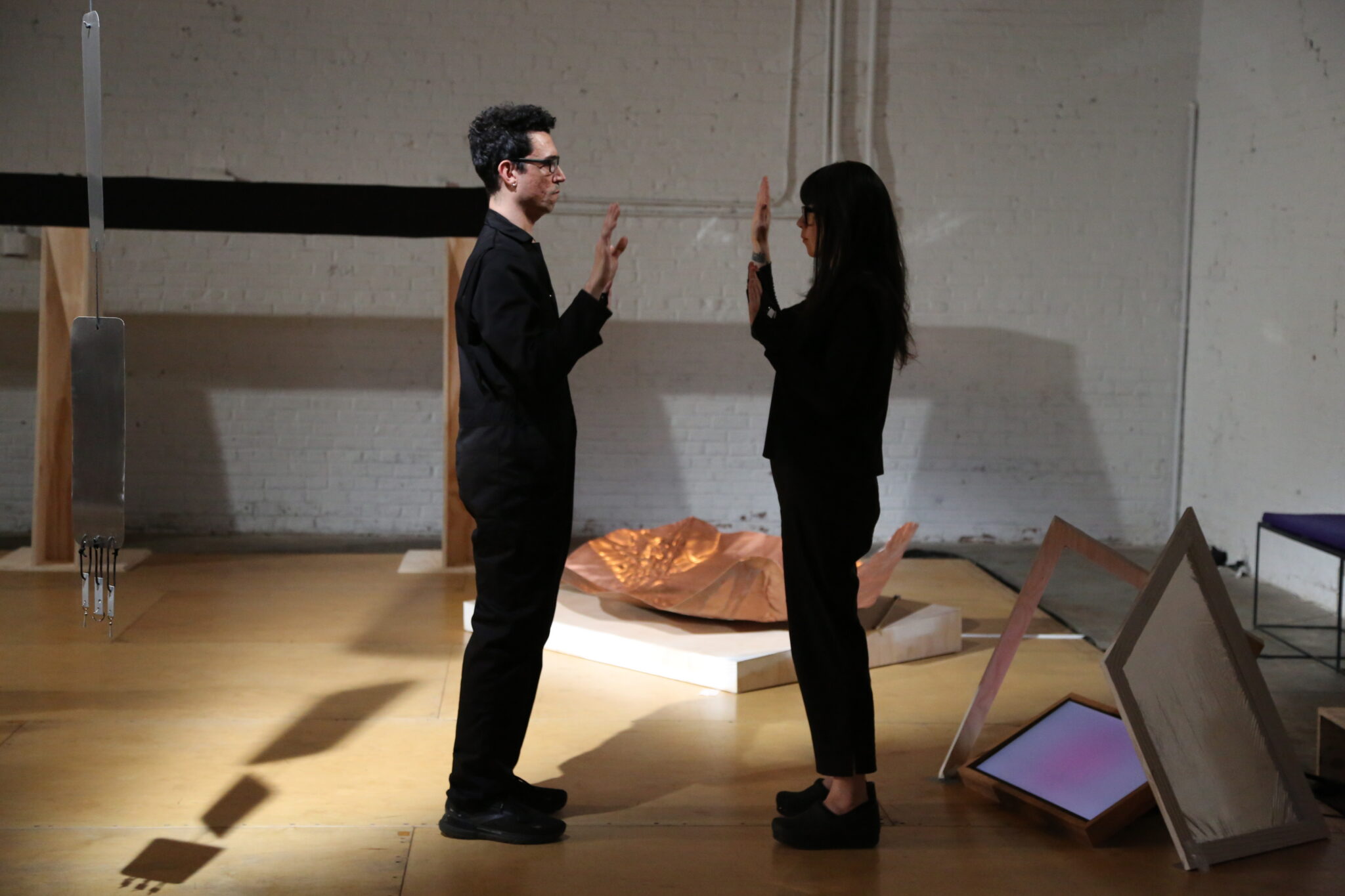
Two people stand facing each other in a dimly lit art gallery. They raise their hands, mirroring each other. Abstract sculptures surround them, creating a contemplative atmosphere.

Photo documentation. Chloe Alexandra Thompson and db amorin, ‘S H I N E: tending the glow,’ 2025, Live performance and installation: 5 channel video, 8 channel + Wave Field Synthesis audio. Presented at the Chocolate Factory Theater, co-produced by Onassis ONX, and supported by a Foundation for Contemporary Arts Emergency Grant. May 29-31, 2025. Image Credit: Brian Rogers.

In terms of the past, during my University days, I studied cultural anthropology, computer science, and Indigenous Nations studies. Given how I grew up, I didn’t think art school was a viable option, and this degree was an excuse for me to write cathartic papers that were blatantly critical of the systems at play while diving into alternative forms of research, which at the time I loved. I was able to engage in this work with culturally embedded Indigenous research and psychology, and with embodied perspectives on how central land, spiritual practice, and relationality were important to healing and decolonization, with support. In the 2010s, there were enactments of bills in Canada, related to long-term reforms of child and family services, (AFN), Indigenous services, care services, that came about, as the now defunct schooling system, both the residential and day schools that were still in operation while I was a kid, which later were addressed as a part of Canada’s Truth and Reconciliation Commission.

I was also able to start reconnecting with my own family, and my own land, and begin to be a part of processes such as working with my tribal council and consultants around off-reserve care in regards to Bill C-92, now the “Act respecting First Nations, Inuit and Métis Children, Youth and Families”. It affirms Indigenous jurisdiction over child welfare, prioritizing prevention, family unity, and cultural continuity. The experience of working on this, as a former youth in care, showed me how to effectively enact futurisms that begin to unpack and resolve past events, making the future different for others as a form of repair. From this, negative experiences become utilized towards the betterment of others, which, to some extent, is a form of healing. In this same way, I have been privileged enough to learn so much from my relative Crystal Lameman around our nation’s Defend the Treaties Trial (Raven Trust donation link), which is a slower process that has been ongoing since 2008—see the above link regarding the timeline and to provide monetary support to my nation’s work.

RAVEN is a registered charity that works to support Indigenous Nations who are upholding their rights in court.

There was a time before all this happened when I didn’t allow myself to dream. Dreaming is so important to living well in any regard, especially in an artist’s practice. By making, witnessing, and being engaged in various collaborative forms of relational worlding—through art and the enactments of Sovereignty I have witnessed and been privileged to be part of—I have learned how to dream and how it requires a practice of reciprocity and giving back. Long-term stewardship, which defies transactional processes, is a form of healing, often found within a community or with land (especially with the understanding that our bodies are inherently a part of the land). This process has kept me connected to the work of communities across the land while living far from home. It informs my own ability to dream and build a life where I can funnel back and practice enrichment on a material level, to help others. 

While living in New York, I became connected to the art & food sovereignty project Iron Path Farms through my work with First Nations Performing Arts. The founders of the project, Dio and Rad, have a rematriation practice that incorporates seed-saving, mutual aid distribution, and community building on Dio’s Haudenosaunee* homelands. Collaborating with people engaged in Land Rematriation in the US, both directly with Iron Path Farms and theoretically with FNPA, has been a really beautiful opportunity to learn to dream bigger and to operate from a place of security while working towards Sovereignty through direct, actionable work. 

*Note for reader: Called the Iroquois Confederacy by the French, and the League of Five Nations by the English, the confederacy is properly called the Haudenosaunee Confederacy, meaning “People of the long house.” The confederacy was founded by the prophet known as the Peacemaker with the help of Aionwatha, more commonly known as Hiawatha. The confederacy, made up of the Mohawks, Oneidas, Onondagas, Cayugas, and Senecas, was intended to unite the nations and provide a peaceful means of decision-making. 

Chloe Alexandra Thompson and db amorin, Knowledge of Wounds, 2023, 5-channel video, 11.2-channel audio. Presented at Performance Space New York. With: Billy-Ray Belcourt (Driftpile Cree), Demian DinéYazhi’ (Diné, Naasht’ézhí Tábąąhá and Tódích’íí’nii clans), Ellen van Neerven (Mununjali Yugambeh), Jazz Money (Wiradjuri), Joshua Whitehead (Oji-Cree), Alison Whittaker (Gomeroi), Hannah Donnelly (Wiradjuri), and Manu Tzoc (Maya K’iche’). Organized by S.J Norman (Wiradjuri) and Joseph M. Pierce (Cherokee Nation Citizen). 

“Sound naturally became a way to explore embodiment and play with the environment in a way that I felt more direct than before.”


Land Back in Turtle Island is a process of returning land, Indigenous governance, and cultural restoration. This process does not focus on continuing the forced removal of people, nor on exercising punitive measures that we see in what’s happening with ICE, which is a colonial society’s way of operating. Land Back is also a process of healing intergenerational trauma that requires a lot of translating between the many worlds, that of lawyers, institutions, and mediating that with Indigenous methodologies, with support and resources needed to traverse this plurality of realms.

My practice is inherently interdisciplinary, collaborative, and research-driven; I approach my work engagements as opportunities to create shared experience(s), rather than an individuated project. I hope to engage with the cohort through listening sessions, technical experimentation, and informal conversations around how artists are responding to emerging technologies and our present climate. Rather than positioning the artist as an isolated author, I view creative work as something that emerges through relationships with people, environments, and technologies.


How did you start to focus your exploration of sound as a medium?

CT: I was building installations that would end up as waste or not really repurposable. It felt like that way of making work and accumulating waste did not line up with my own thoughts and daily practice around ecology. Because of that, the way I build things now is different. I shifted into a way of working that incorporates sound because the equipment is reusable. Sound naturally became a way to explore embodiment and play with the environment in a way that I felt more direct than before.

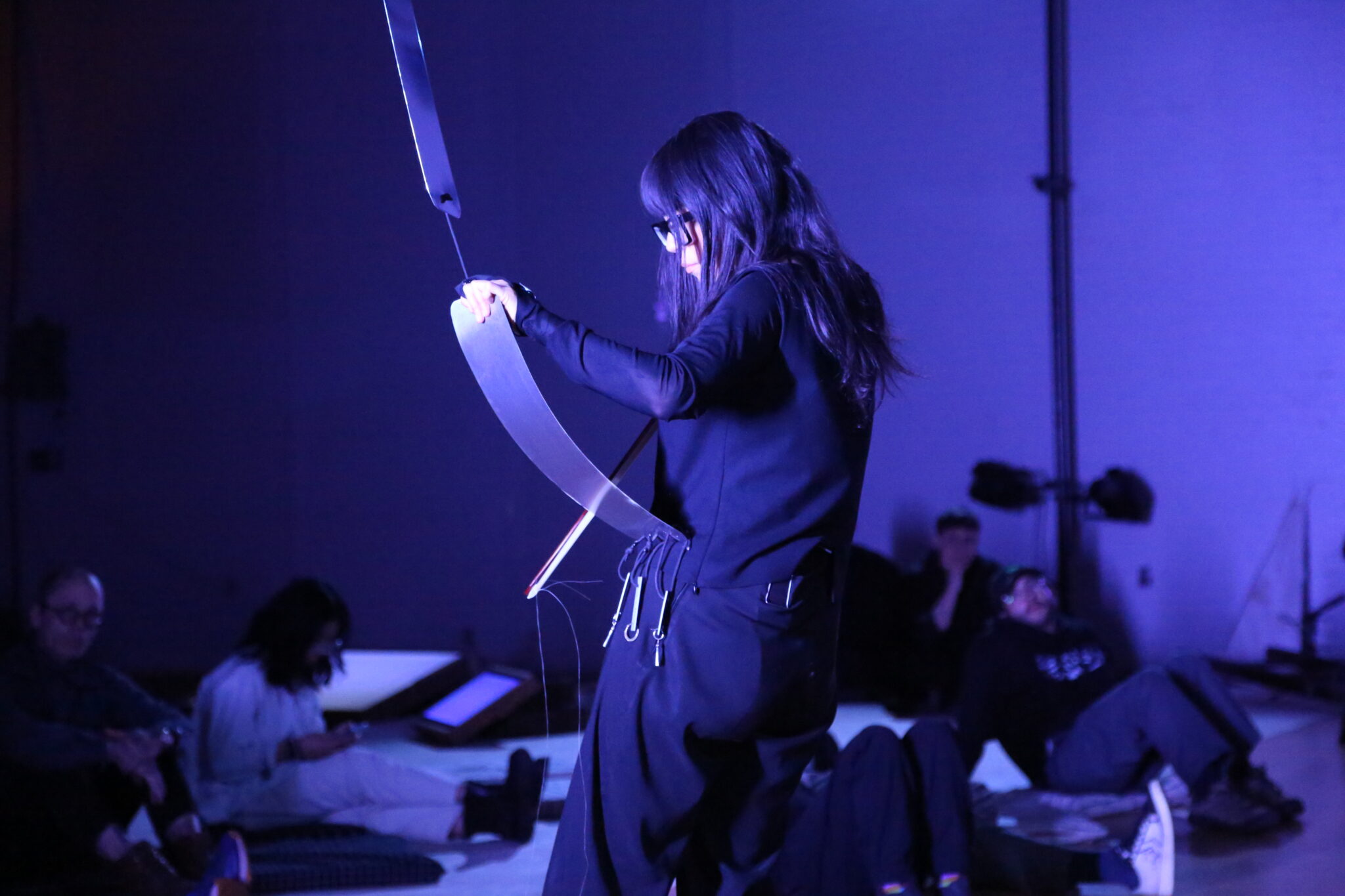
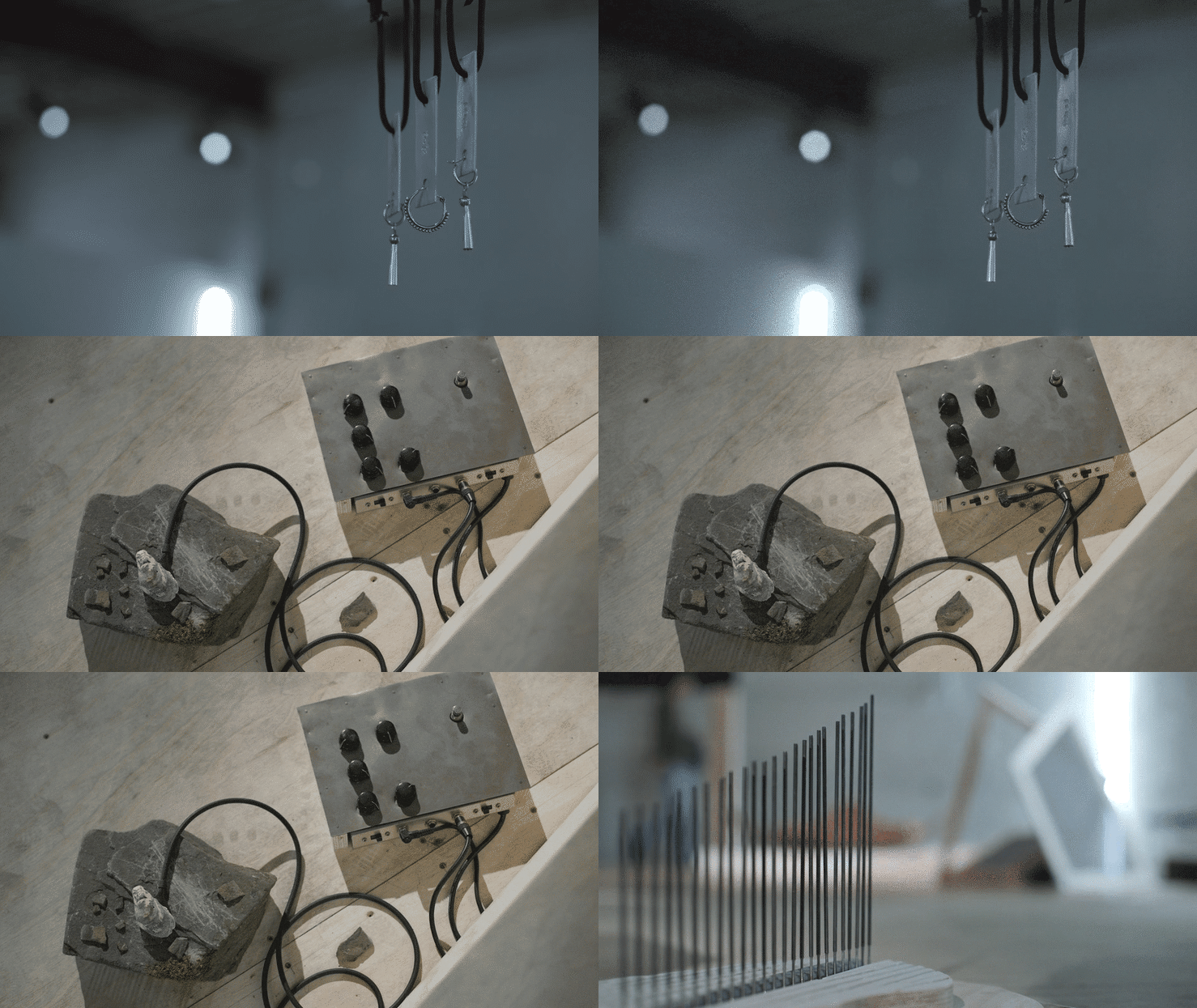
Person dressed in black performs with a metal strip, using a violin bow to create sounds on a bent thin sheet of metal, that's connected to a series of metal hanging from the ceiling. The space is under blue lighting, creating a contemplative atmosphere. Seated audience watches intently.

Photo documentation. Chloe Alexandra Thompson and db amorin, ‘S H I N E: tending the glow,’ 2025, Live performance and installation: 5 channel video, 8 channel + Wave Field Synthesis audio. Presented at the Chocolate Factory Theater, co-produced by Onassis ONX, and supported by a Foundation for Contemporary Arts Emergency Grant. May 29-31, 2025. Image Credit: Brian Rogers.

Sound can have a naturally calming effect on the body. It’s so linked to our own survival mechanisms that it can also create emotional environments or a sense of journey that brings you to a point of catharsis, where you face that scary feeling. Still, it can also be engineered to bring tranquility or reflection. Through sound, I have been able to dive into sensitive topics without addressing them directly in a way that is embodied, not just abstract but palpable. Another important part of this process is that sound can create a space for communal healing, helping dysregulated people regulate their nervous systems. You can’t begin to have repair when people are dysregulated, so it feels important to create a shared space for people to settle into their bodies as a point of connection before launching into the work.

I focused on exploring how one moves into a space of repair through sonic scapes. Overall, we have to figure out how repair looks on the body; decolonial praxis is embodied. Allowing that capacity for oneself allows it for others. Through this project and residency, I am looking to be more direct in how I approach my work and how I communicate about it. 

“The focus is on relationality and agency using sound, video, voice, movement, and audience participation to explore space as a living entity, shaped through deliberate, reciprocal actions rather than fixed roles of subject and object.”


What project did you feel incorporates sound in this embodied way?

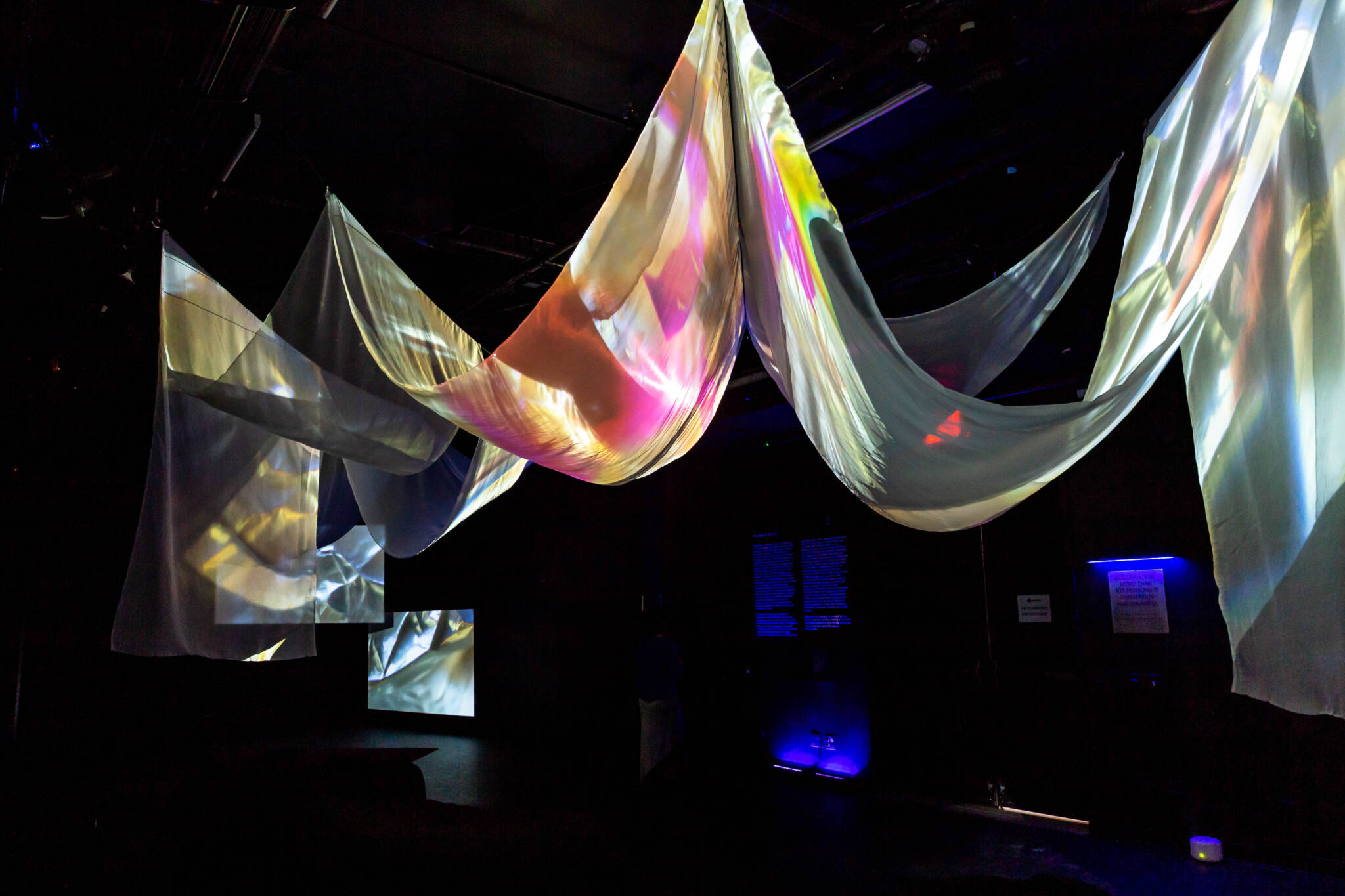
CT: S H I N E, 2025, is a project where I expanded the exploration of embodied sound. It’s a large-scale performance and installation, created in collaboration with DB Amorin. The presentation of this project reimagined the Chocolate Factory Theater’s cavernous post-industrial space as an activated audio environment.  DB designed the video for the piece and was a co-thinker and co-steward of the process. I wrote our text, did the sound design, and creative technology. DB and I both performed. We also worked with devynn emory on choreography, Joseph M. Pierce as dramaturge, itohan edoloyi as lighting designer, Marshall LaCount on scenic design and fabrication, and Eric Heep, who provided custom LiDAR tracking software for my interactive programming.

Chloe Alexandra Thompson and db amorin, S H I N E: tending the glow, 2025, Live performance and installation: 5 channel video, 8 channel + Wave Field Synthesis audio. Presented at the Chocolate Factory Theater, co-produced by Onassis ONX, and supported by a Foundation for Contemporary Arts Emergency Grant. May 29-31, 2025

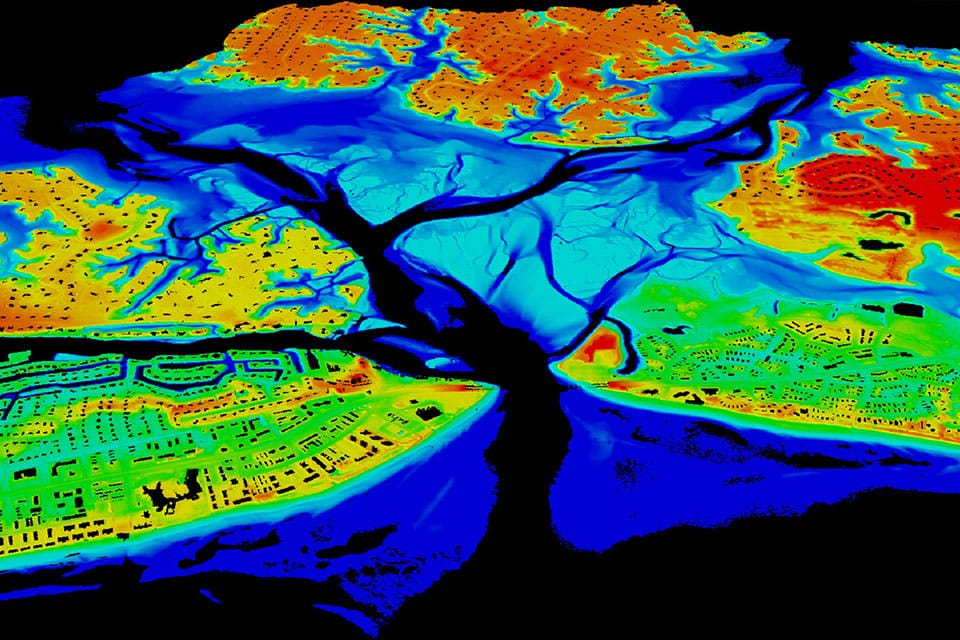
This immersive performance used a LiDAR tracking (Light Detection and Ranging) system, which is typically used to map warehouses, survey land, and forecast floods. The specific sensors we used expressly do not allow this technology to be used for weapons; only use cases are non-lethal and supportive. Overall, it is an environmental monitoring system that emits laser light that reflects off objects, measuring the two-way travel time to calculate precise distances. It is interesting to see how these technologies know where everything is with such precise efficiency; it seems like the very expression of capitalist success ever achieved. 

LiDAR was (mis)used as a tool to imply an experience of Indigenous ways of relation to that which is not human. The work used abstracted poetic allegories, which were heard in spoken text, both embodied through our bodies in performance and disembodied as sound holograms arriving discretely to the audience’s ears through wave field synthesis and the tracking system, or through the overall PA system. The focus is on relationality and agency using sound, video, voice, movement, and audience participation to explore space as a living entity, shaped through deliberate, reciprocal actions rather than fixed roles of subject and object, and the delicate machinery of intentional, communal action. I wanted to open a conversation around dreaming—collectively.

LiDAR image of Lynnhaven Inlet, Virginia. (Source: National Oceanic and Atmospheric Administration’s National Ocean Service, Digital Coast Data Sets)

I worked with Eric Heep, who developed software using openFrameworks that interpreted LiDAR data points into OSC* for the interactive Max patch* I programmed, allowing movement created by me, DB Amorin, and the audience to activate sound. And for the sound to become “3D”, we used a Wave Field Synthesis* array provided by artist, Andrew Schneider.

*Notes for readers: OSC is Open Sound Control, a protocol for networking sound synthesizers, computers, and multimedia devices.

Interactive Max Patch is a visual program built in Cycling ’74’s Max/MSP/Jitter environment that responds to real-time input (MIDI, mouse, camera, sensors) to control audio or visuals. Patches use objects connected by patch cords to process data, creating everything from gestural instruments and generative music systems to video tracking applications. 

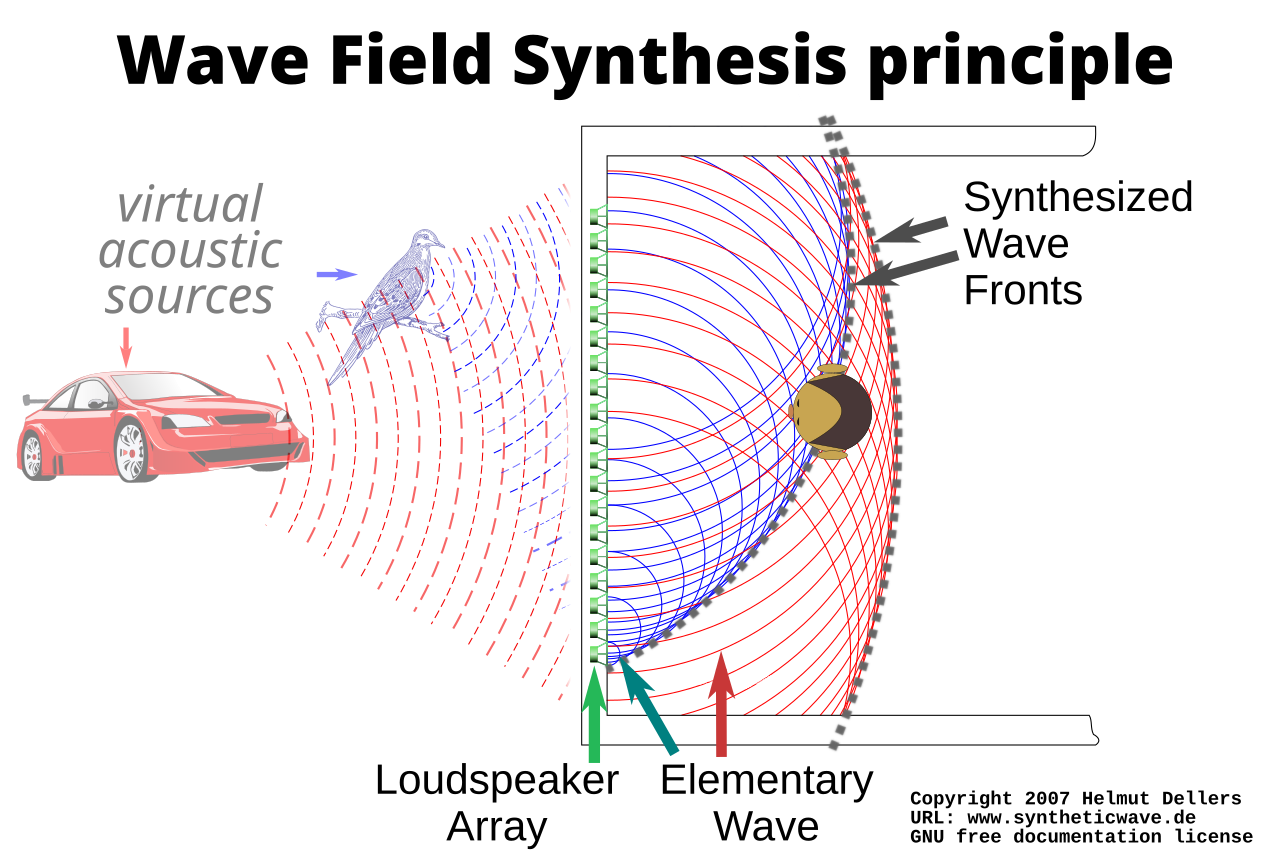
Wave Field Synthesis (WFS) is a spatial audio rendering technique that recreates 3D sound within a specific area.

“Technology can create the opportunity for a state of being ‘with’ rather than a static ownership or hierarchical dynamics.”


Principle of wave field synthesis. Helmut Oellers at www.syntheticwave.de. (Sourced from https://en.wikipedia.org/wiki/File:Principle_wfs_2.svg)

The work emerges from a question: “While walking with our ancestors and future ancestors, what is a balm that moves backward as well as forward?” The work addresses relationality, how important the connection between the immaterial and material is to each other, how important space and objects are in a living system, and how behaviors through proximity become constellations that are formed by our movement. What meaning is held or seen in those instances? I wanted to focus on multiple nodes of connection: Human to Human, Human to non-Human, Human to more-than-human beings. This is reductive, and I am only learning, but in the Cree language, there were no pronouns, and most nouns are not so simple: to name something often is more so to discuss the state of being or its actions and one’s relation to them than to flatten it into any one state. I hope to channel an alternative reality, rather than a colonial structure, understanding that there’s no separation between anything, but rather an engagement with a series of states.

What I appreciate about Technology and New Media art is how these modalities can highlight the point of relationality and state dependency, allowing one to easily acknowledge the system and then decentralize it. Through removal and poetic meditation. Centering love, the allegory for all the care we give each other. Technology can create the opportunity for a state of being “With” rather than a static ownership or hierarchical dynamics.


It’s interesting to see how you meld the material practice of Land Back with acoustic ecology; it’s a relationship many of us neglect to link. We would love to hear more about how you explore this through your ongoing work, ‘Untitling.’ 

Screen recording. Chloe Alexandra Thompson, Untitling, 2025. Essay and Audio. High Pitch Magazine, May 12, 2025, Article, Issue 02.

CT: Untitling is a work that explores how indigenous epistemologies [theory of knowledge] can guide experimental media systems towards openness, relationality, and plural-ness. The work advances a reclamation-based acoustic ecology that understands sound as relational, embodied, and sovereign rather than an extractive force. Through the work, I ask: what becomes possible when dance and song are restored as necessary to the life and survivance of Turtle Island? The project approaches sound as an agent of responsibility, where each being carries distinct calls and temporalities. While humans can extend the range of sound through technology, colonial extraction [which is baked into technology] has altered their frequencies. Untitling seeks to listen to these altered frequencies, where signals have been interrupted or erased, and to hold space for fragments, gaps, and returns as sites of possibility. The essay [published in High Pitch Magazine] is the first public showing of this work.

The project builds on ongoing research that develops a reclamation-based definition of acoustic ecology, in collaboration with Dr. Lisa Ann Schonberg, and is informed by Indigenous methodologies, understanding ceremony as an active ecological force shaping memory, behavior, and restoration. Untitling places Indigenous frameworks in dialogue with environmental studies on acoustic enrichment, which includes initiatives to restore coral reefs, and with family testimony connected to Crystal Lameman’s leadership in the Defend the Treaties Trial, foregrounding sovereignty as a lived responsibility.

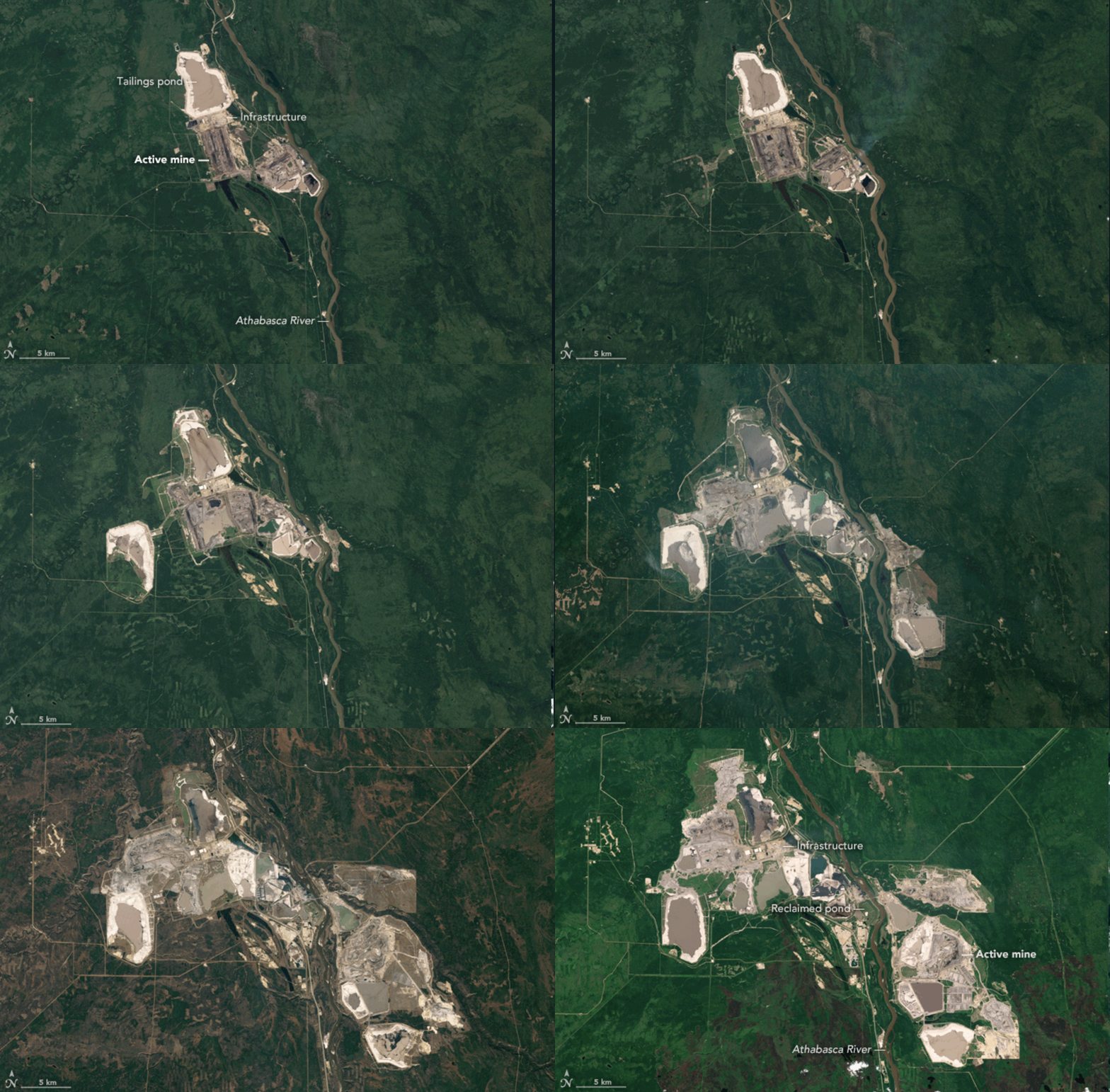
GIF by Chloe Alexandra Thompson of photos from NASA’s Earth Observatory World of Change: Athabasca Oil Sands. Years featured: 1984, 1987, 1989, 1990, 1996, 2000, 2004, 2005, 2008, 2010, 2013, 2016. (Source: NASA Earth Observatory.)

CT: Untitling frames listening as a relational technology capable of reshaping how we inhabit shared environments. The work investigates how sound might offer alternative models of collective space at a time when digital infrastructures increasingly determine how we perceive the world. 

Contemporary algorithmic systems organize reality through classification, prediction, and surveillance. These systems flatten complexity into profiles and datasets, producing parallel realities that reinforce sameness while obscuring multiplicity. In this instance, sound is a counter-framework: a medium that cannot be fully captured, categorized, or contained. Sound leaks across boundaries, moves through bodies, and shifts our perception—this is easily understood in how we experience nervous systems responding to sound (e.g., films), and how we are beginning to learn that animals respond to their environments through listening as well. I am interested in the idea that there are qualities of sounds that exist as right relations or tending, and how these sounds could potentially help us tend to the land.

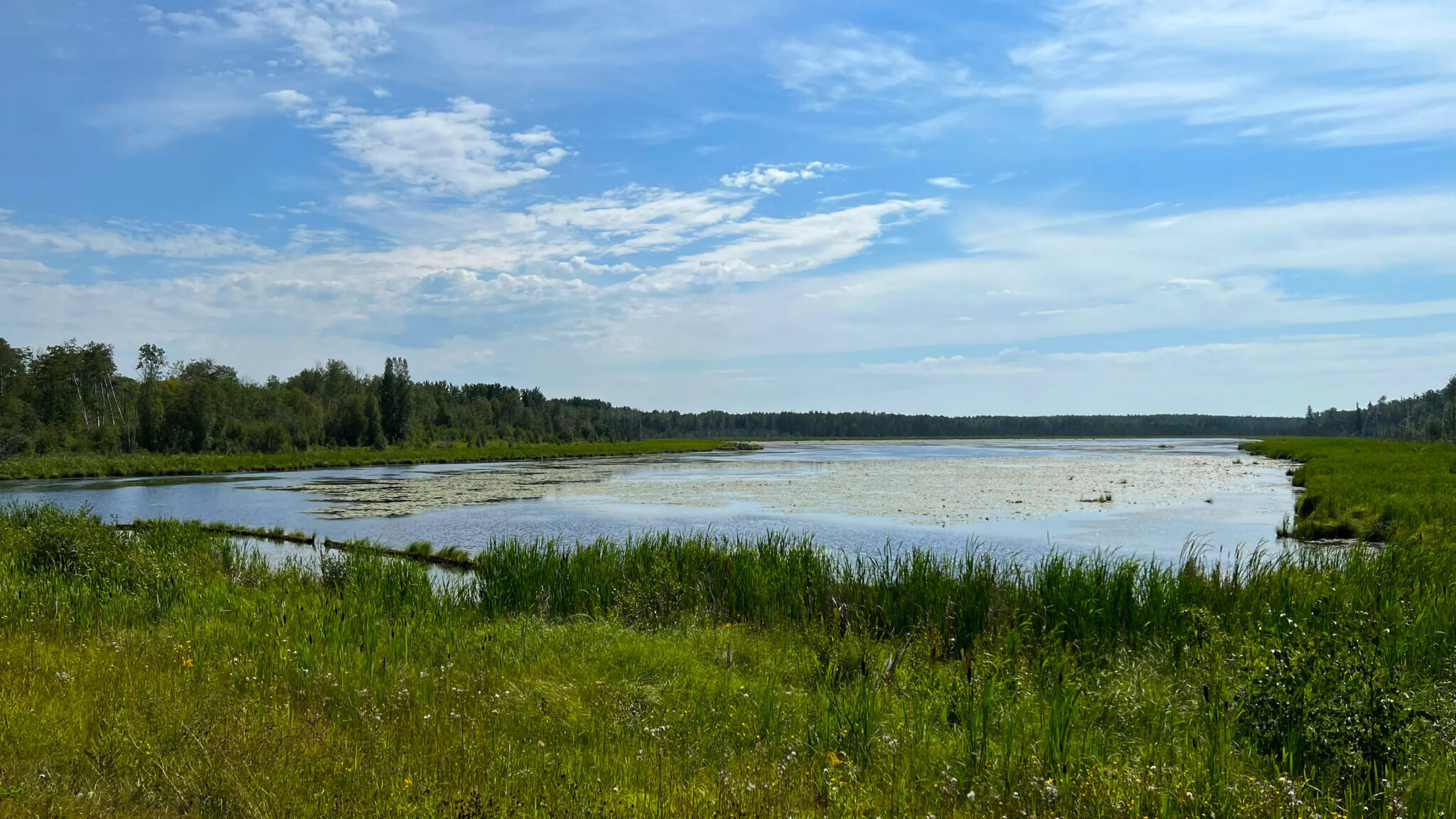
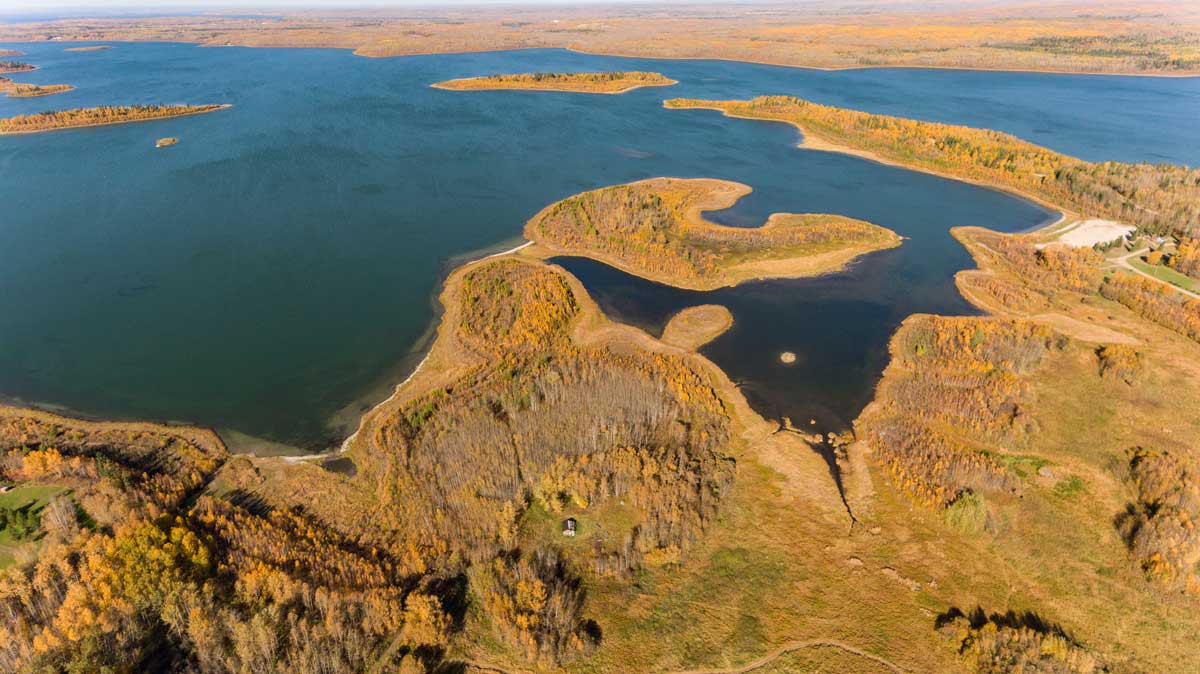
Brayet Lake near the Beaver Lake Cree Nation Powwow Grounds. Photo Courtesy of the artist.

Untitling understands listening as a relational practice grounded in responsibility to land and community. In this framework, informed by Indigenous knowledge systems, sound is not representation but presence. The project asks how Indigenous listening frameworks might inform technological systems that privilege reciprocity, ambiguity, and plurality.


How are you planning to develop Untitling through this residency?

CT: During the residency, I plan to develop research and prototypes for responsive spatial audio environments using generative sound systems and various sensing technologies (e.g., cameras, LiDAR). These systems will explore how environments might respond to collective movement without producing individual data profiles. 

One way I use spatial audio is by repeating or syncopating meaningful fragments, creating a sonic environment with distinctive sounds that allows each person to either listen to it as a single piece or to focus on a specific sound that stands out to them. The audience is tasked with deciding what to focus on. It gives the audience agency; the sound is not just a wall, people can choose to move around, and it becomes a point of access. I am interested in using sound as a medium to express feelings, bring people into dialogue, and create a thoughtful space.

Gif Excerpt. Chloe Alexandra Thompson and db amorin, ‘S H I N E: tending the glow,’ 2025, Live performance and installation: 5 channel video, 8 channel + Wave Field Synthesis audio. Gif by Peter Richards.

I am also interested in building a physical instrument. I have been working with shells, tree bark, and branches. I am looking to start 3D-scanning objects and exploring ways to incorporate the tones and textures [of natural materials] into custom fittings for strings and other components. 

The residency will function as a laboratory for experimentation, conversation, and sonic prototyping. Rather than completing a fixed artwork, I aim to develop conceptual and technical foundations for a larger work while engaging in dialogue with peers about how artists can imagine technological systems that support pluralistic futures rather than standardized realities.

Another part of this project, that I will get to eventually, as this is an ongoing process, will be Interviewing my cousin, Crystal Lameman a nêhiyaw mother of two and a proud member of BLCN, who is a fierce environmental defender, researcher, and policy analyst, who is a vital part in mobilizing Beaver Lake Cree Nation along with RAVEN Trust to take the Canadian government to court over 17,000 treaty violations over the ecological destruction not limited to water pollution, demise of wildlife habitation, and polluted cultural agriculture incurred by the Tar Sands.

The lands of the Beaver Lake Cree Nation. Photo courtesy of RAVEN Trust.

In May 2008, the Beaver Lake Cree Nation filed a Statement of Claim in Alberta’s Court of Queen’s Bench, taking the Government of Canada to court. In March 2012, they were granted a trial. This Lawsuit is the first time that any Nation has taken the Crown. There’s a lot of precedence in this Lawsuit. The work has been going on for over 18 years, so it’s been hard to talk about, given the lack of press coverage. This is incredibly important.

My practice as an artist is secondary to its usefulness. I think a lot of working in relation is thinking about how things will happen in their own time. Especially since Crystal and the many others involved in the trials are still deep in the process.

“Through immersive environments, [my practice] asks how technologies might support collective experience without collapsing difference, offering speculative models for shared futures that embrace multiplicity.”


Screen recording and Audio Excerpt from Soundcloud. Essay Chloe Alexandra Thompson, Untitling, 2025. Essay and Audio. High Pitch Magazine, May 12, 2025, Article, Issue 02.

How do you grapple with the themes of speculating on plurality in your work? 

CT: The theme Speculating on Plurality resonates deeply with my work because sound is inherently plural. Multiple vibrations coexist within shared space, interacting and reshaping one another continuously. Listening requires navigating complexity rather than ignoring it as an attempt to resolve it.

In contrast, many contemporary technological systems attempt to simplify reality by categorizing individuals into profiles that can be predicted and monetized. These infrastructures prioritize legibility and control, often producing forms of sameness that flatten cultural and perceptual diversity. 

I explore how spatial sound systems and distributed media elements might model different forms of technological interaction. Rather than designing systems that identify individuals, I am interested in creating environments that respond to collective or individual presence. These systems allow perception to emerge through shared movement rather than algorithmic prediction.

I am particularly interested in how Indigenous knowledge might inform deep listening frameworks to create alternative technological imaginaries, where sound is understood as a living presence within ecological relationships rather than emanating from “objects” to be captured or owned. Through immersive environments, [my practice] asks how technologies might support collective experience without collapsing difference, offering speculative models for shared futures that embrace multiplicity.

As someone whose practice is often easiest to describe through sound while being quite plural, very based in research, personal experience, and interdisciplinary formats, I often consider where am I not allowing that work to be visible?

Eyebeam models a new approach to artist-led creation for the public good; we are a non-profit that provides significant professional support and money to exceptional artists for the realization of important ideas that wouldn’t exist otherwise. Nobody else is doing this.

Donate today