Two open calls for residencies, more details here. Apply now!
Tue - Sat, 12 - 6PM / 212.937.6580 / 540 W 21st St. New York, NY 10011
HANDS-ON GET-UP!
HANDS-ON GET-UP!
HANDS-ON GET-UP are a series of reconfigurable, wearable installations that aim to explore tactile expression and shared creativity through clothing. Questioning issues of personal and private space, these wearable structures hope to re-evaluate the fabric of individual and social identity. As a child, clothing is so much more than protection from the elements. It is our first instrument of expression. If we pull our sweater over our eyes we can become invisible. Tugging on our sleeves we can make our hands disappear. The zipper on our coat becomes a first musical instrument. And if we flip our jacket over our head we create a shelter for a friend in the rain. Our clothing becomes the fabric of an unselfconscious, improvised dialect.
HANDS-ON GET-UP aims to explore the possibilities of clothing as a social tool for singular or collective communication. Can a wearable structure become a canvas for playful discovery? Are inhabitants of these structures able or inclined to become adventurers of their own portable space? How do co-habitants of the surrounding environment respond? Can this become a collaborative experience that draws people together? Through a series of creative workshops, I propose to develop a set of mechanical reconfigurable garments that initiate proactive interaction between wearer and wearers. An extension of clothing, they will be used to encourage social exchange, simultaneously unveiling a series of potential narratives. As transformable wearable sculptures, they will challenge expectations of those around us.
ITP Thinking Physically Class with Kate Hartman
On April 1st between 9:30-12:00, we have arranged a body-mapping workshop with Kate Hartman's Thinking Physically group. The plan is to explore instances of isolation and unexpected connection within the city space through personal reflection and on-street observation and sketching. The group will then be asked to, fast-prototype a body-centric device that relates to their chosen story, with an aim to initiate playful encounters within the urban space. These artifacts will then be road-tested. We will document both the expected and unexpected response of pioneers.
The Rhythmanalysis Lab is concerned with the observation, representation, and interpretation of rhythms in everyday life. Inspired by the work of Henri Lefebvre, it is a framework for projects, workshops, and investigations at the intersection of urban research, sound, and data science.
Will the (future) rhythmanalyst ... set up and direct a lab where one compares documents: graphs, frequencies and various curves? ... Just as he borrows and receives from his whole body and all his senses, so he receives data from all the sciences: psychology, sociology, ethnology, biology; and even physics and mathematics ... He will come to 'listen' to a house, a street, a town, as an audience listens to a symphony.
- Henri Lefebvre, "The Rhythmanalyst: A Previsionary Portrait" in Rhythmanalysis: Space, Time and Everyday life. New York City: Continuum, 2004. Pg. 22.
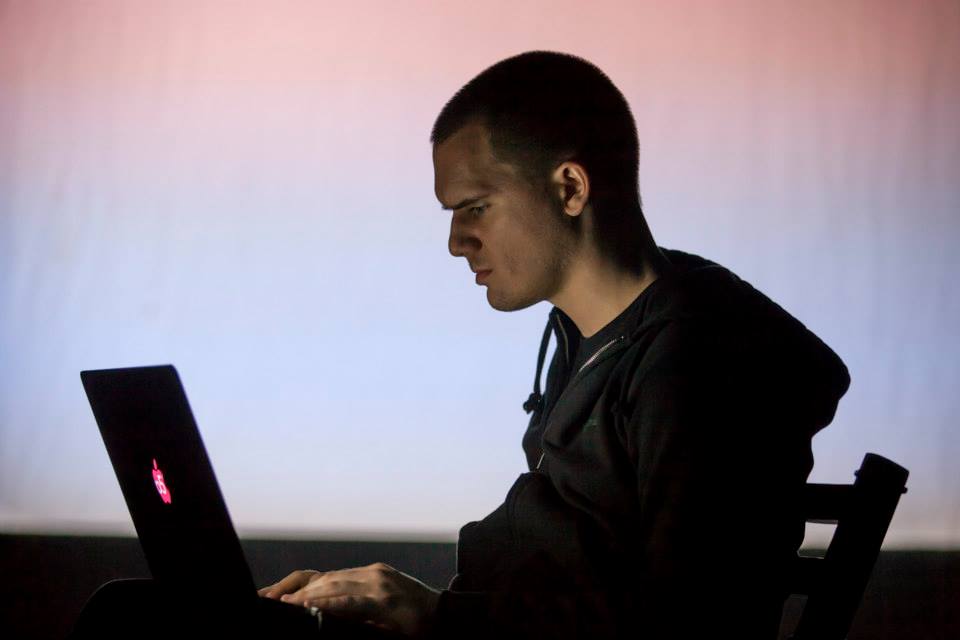
Forty-eight to Sixteen documents my daily commute from Brooklyn to midtown Manhattan with sensors for my heartrate, breathing, and the cadence of my pedaling, along with chest-mounted video. Cellist Topu Lyo interprets my experience via a composition I derived from the sources that is precisely timed with the video. I am interested in 'performing' data and my and Topu's divergent but equally physical relationship to the information. Additionally, the physiological basis of empathy has implications for recent trends in media culture toward first-person viewpoints and the integration of biometrics into documentary. (Named after the gear ratio of my bike.)
http://brianhouse.net/works/forty_eight_to_sixteen/
6PM-8PM, Tuesday, June 19
What new strategies and tactics for the occupation of urban space have emerged over the past year? Join us for an informal public conversation with Nato Thompson, chief curator at Creative Time, and Beka Economopolis and Jason Jones of Not An Alternative on the emerging confluences of art and activism as they relate to contemporary conditions of urban space. This Urban Research Group conversation series aims to address the underlying issues, ideas and interests that drive the research of its current fellows and residents.
A small crowd assembles in Eyebeam’s mainspace. Rows of red, metal chairs have been hastily arranged facing an elevated stage upon which perches a pair of welcoming armchairs. Two artists will soon be dialog, Eyebeam fellow Mark Shepard and honorary resident Jordan Crandall. For many years, both artists have been engaged with problems of data and urbanism, an interest that has inflected their respective works at Eyebeam. Mark and Jordan have organized this evening’s dialogue to discuss the following prompt: What constitutes the urban today? Or, perhaps more precisely: how might we think about the constitution of the urban today? It is a conversation that has been incubating for several months in Eyebeam’s Urban Research Group.